The sources highlight two primary industry trends in automotive thermal management systems, particularly within the evolving landscape of new energy vehicles (NEVs):
- Integration of Thermal Management Systems
- Advancement to Carbon Dioxide (CO2 or R744) Heat Pumps
These trends are driven by the increased complexity and crucial importance of thermal management in NEVs, which need to manage heat for the battery, motor/electronic control, and cabin heating efficiently to ensure safety, performance, and extended driving range.
1. Integration of Thermal Management Systems
What it is: Integration refers to a design and manufacturing approach where functions traditionally handled by multiple separate components are combined into a single modular unit. This allows one module to replace several individual parts, leading to a more streamlined system.
 Schematic Diagram of Integrated Thermal Management System in Electric Vehicles
 Integrating components can lower the overall manufacturing and assembly costs.
Expanded System Space (Compactness): It leads to a more compact structure, saving valuable space within the vehicle.
Lower Weight and Volume: Fewer individual parts and connectors reduce the overall weight and volume of the thermal management system.
Improved Energy Efficiency: Integrated systems are designed for lower thermal management energy consumption and a wider operating temperature range. For instance, a highly integrated system can achieve a 100% improvement in energy efficiency.
Enhanced System Performance and Reliability: By reducing the number of connections and optimizing the layout, integrated systems can improve the matching of components and increase reliability. Huawei's TMS, for example, achieves a 60% increase in calibration efficiency.
Better Heat Utilization: Integrated systems fully utilize heat from sources like the heat pump, motor waste heat, and compressor heat to provide supplementary heating, effectively eliminating the need for high-voltage PTC heaters for general heating.
Simplified Assembly: It can lead to a significant reduction in the number of pipes (e.g., 40% reduction) and assembly workload (e.g., 60% reduction).
Challenges:
Increased Control Complexity: While the physical structure simplifies, the control strategies for integrated systems become more complex to manage different thermal demands across various environments and systems.
Examples and Implementation:
Tesla Model Y is noted for first introducing the concept of integrated thermal management, featuring a heat pump air conditioning system, low-voltage air-heating PTC (for supplementary use), motor, compressor, an "eight-way valve," control valves, water pumps, and an overflow tank. This system highly integrates structure, is compact, low-cost, and effectively utilizes heat. The "eight-way valve" is a key component in Tesla's integrated system.
Other manufacturers are following this trend, with models like BYD Dolphin and vehicles equipped with Huawei's TMS system (e.g., Avita 11) adopting integrated solutions.
BYD Dolphin specifically uses integrated heat pump technology with direct cooling and heating for its blade battery, using refrigerant directly over traditional coolant. Its complex refrigerant architecture includes six solenoid valves and three electronic expansion valves for various functions like
battery heating/cooling and cabin heating/cooling.
Related Reading:
BYD Dolphin Heat Pump System
| S/N |
Definition |
| 1 |
Battery Heating Solenoid Valve |
| 2 |
Battery Cooling Solenoid Valve |
| 3 |
Air Heat Exchange Solenoid Valve |
| 4 |
Water Source Heat Exchange Solenoid Valve |
| 5 |
Air Conditioning Heating Solenoid Valve |
| 6 |
Air Conditioning Cooling Solenoid Valve |
| 7 |
Refrigeration Solenoid Expansion Valve |
| 8 |
Heating Electronic Expansion Valve |
| 9 |
Intercooler Bidirectional Electronic Expansion Valve |
Thermal Management Integrated Module, integrating various solenoid valves into one unit
Huawei's TMS boasts the industry's highest integration, combining 12 components (compressor, PTC, etc.) to reduce pipe count by 40% and assembly workload by 60%. It features an ultra-low temperature heat pump (-18°C) for wider application.
Impact on Components:
The integration trend specifically drives a new demand for automotive rubber hoses. Rubber hoses are vital for circulating coolant in NEV cooling systems. With the shift to
heat pump technology and integrated whole-vehicle thermal management, the demand for piping significantly increases. Pure electric vehicles might use 20-35 sets of pipes, and hybrid vehicles up to 40-50 sets, compared to 11-16 sets in traditional cars. This means a 3x increase in usage volume. The single-vehicle value of rubber hoses in NEVs can be 2-3 times that of traditional fuel vehicles, with new energy vehicles using about 46 meters of piping per vehicle. The new requirements include high temperature, high pressure, sealing, and low residual oil properties for the hoses.
2. Advancement to Carbon Dioxide (CO2 or R744) Heat Pumps
What it is: This trend involves
the adoption of heat pump air conditioning systems that use carbon dioxide (R744) as the refrigerant. This is seen as a promising alternative to current NEV cabin heating solutions.
Why it's Important (Benefits):
Environmental Friendliness: CO2 (R744) has a Global Warming Potential (GWP) of 1, making it significantly more environmentally friendly than R134a (GWP of 1430) and even R1234yf (GWP of 1). Regulatory pressures, especially in Europe, are phasing out high-GWP refrigerants.
| Property |
R744 |
R134a |
R1234yf |
| Chemical Formula |
CO2 |
CF3CH2F |
CF3CF=CH2 |
| Relative Molecular Mass |
44 |
102.03 |
114.04 |
| Boiling Point / °C |
-78 |
-26.1 |
-29.4 |
| Critical Temperature / °C |
31 |
101.1 |
94.85 |
| Critical Pressure / MPa |
7.38 |
4.059 |
3.38 |
| GWP |
1 |
1430 |
1 |
| Safety Classification |
A1 |
A1 |
A2L |
| Characteristics |
High efficiency, low cost, pressure increase |
Not environmentally friendly |
Patent restrictions, poor cooling efficiency |
Performance Comparison of R134a, R744, and R1234yf Refrigerants
Superior Heating Efficiency: R744 heat pumps offer excellent heating performance, even in very cold temperatures. They can maintain a Coefficient of Performance (COP) of 2 even at -20°C, which is notably higher than R134a systems. This directly addresses the problem of reduced range in NEVs during winter due to cabin heating. For context, a PTC heater has a COP of 1, consuming 5.5kW for 5kW of heat, while a heat pump consumes only 2.5kW for the same 5kW of heat.
Safety: CO2 (R744) has a safety rating of A1.
Challenges and Increased Value:
High Pressure Requirements: Due to CO2's lower boiling point, the entire refrigeration system must operate at much higher pressures. The high-pressure outlet can reach 18 MPa, with temperatures up to 180°C. This is significantly higher than the 1 MPa pressure and 80°C temperature in traditional R134a systems.
Increased Technical Demands: This necessitates more robust components, leading to higher technical requirements for parts like the
electric compressor, pipes, and valves. It also requires pressure sensors to monitor system pressure.
Material Compatibility: CO2 can react with pipe materials, further increasing technical difficulty.
Higher Cost: The need for specialized high-pressure and high-temperature resistant components drives up the system cost. A CO2 heat pump system's single-vehicle value is estimated at 9,600 yuan, which is significantly higher than a traditional PTC system (5,400 yuan) or an R134a heat pump (6,860 yuan). This increased value is mainly seen in the electric compressor, air conditioning pipes, sensors, and valves.
China Domestic Manufacturer's Efforts:
Chinese manufacturers are actively investing in key components for CO2 heat pump systems, such as electric compressors and electronic expansion valves.
Sanhua Intelligent Controls already supplies CO2 electronic expansion valves, stop valves, check valves, regulating valves, four-way valves, and gas-liquid separators for some European CO2 heat pump models.
Crai Electric is researching high-pressure CO2 piping systems and has passed Volkswagen's MEB experimental certification, moving into pre-batch production.
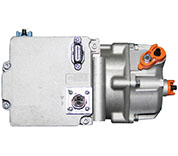
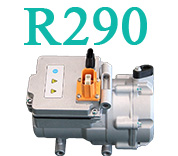
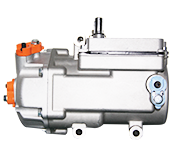
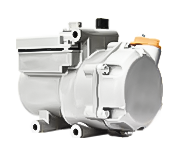
Midea's Welling Automotive has introduced a CO2 rotary electric compressor that can effectively heat even at -35°C, potentially increasing range by 20% compared to traditional heat pumps.
In summary, these trends reflect a continuous effort to optimize energy consumption and enhance the performance and safety of NEVs, moving towards more sophisticated, integrated, and efficient thermal management solutions.




.jpg)