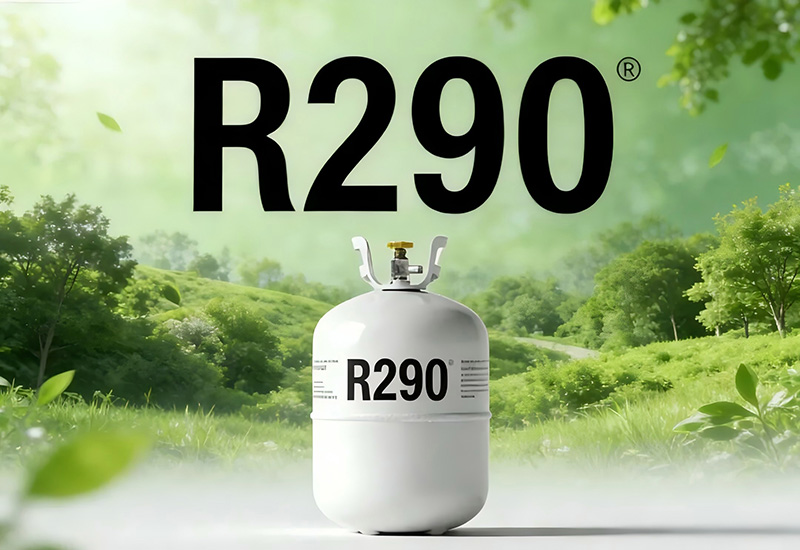
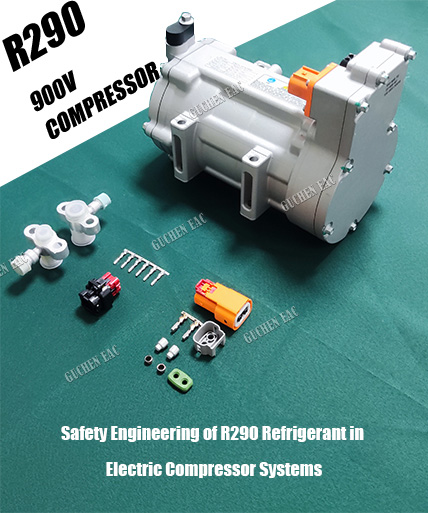
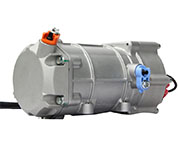
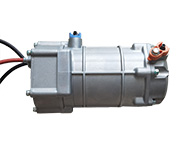
With the rapid development of new energy vehicles, electric commercial vehicles, and energy storage thermal management technologies, refrigeration systems are evolving toward higher efficiency and greater environmental sustainability. In this context, R290 (propane), as a natural refrigerant, has gradually become an important option in electric compressor systems due to its extremely low Global Warming Potential (GWP ≈ 3), high thermal efficiency, and controllable cost.
However, R290 is classified as an A3 refrigerant and is flammable, which imposes higher safety requirements on system design. Therefore, in
electric car ac compressor applications, a systematic safety design approach must be adopted across multiple dimensions—including detection, control, structural design, and electrical protection—to achieve a balance between performance and safety.
1. Leak Detection and System Monitoring
In R290 systems, refrigerant leakage is the primary risk source. Therefore, a multi-layer detection and monitoring system must be established rather than relying on a single sensor.
First, high-sensitivity refrigerant leak sensors should be installed at critical locations such as the compressor housing, pipeline connections, and areas near heat exchangers. These sensors should feature fast response times and be capable of triggering early warnings at low concentration levels, providing sufficient reaction time for the system.
Second, the system should incorporate both pressure monitoring and current monitoring to form a dual-verification mechanism. For example:
- A drop in system pressure may indicate leakage or insufficient refrigerant charge;
- Abnormal fluctuations in compressor operating current may reflect load variations or internal faults.
By cross-validating multiple parameters, false alarms and missed detections can be effectively reduced, thereby improving system accuracy and reliability.
2. Emergency Control Strategies After Leakage
Once a refrigerant leak is detected, the system must immediately enter a “safety-first” mode and execute coordinated control strategies, rather than merely issuing an alarm.
First, immediate shutdown of the compressor is critical. As a high-energy component, continued operation may generate sparks or excessive heat, increasing ignition risk.
Second, the high-voltage power supply should be rapidly disconnected, especially in electric vehicles or high-voltage systems, to minimize electrical risks such as arcing or short circuits.
Third, the system should automatically activate forced ventilation mechanisms. Through fans or dedicated ventilation designs, leaked R290 gas should be quickly diluted and discharged from the equipment compartment or vehicle cabin. This is particularly important in enclosed or semi-enclosed environments.
Additionally, advanced systems may incorporate multi-stage response strategies (e.g., early warning, power limitation, forced shutdown) to enable more refined safety management.
3. Optimization of Piping and Sealing Design
Structural safety is equally critical in R290 system design. Proper piping and sealing design can significantly reduce the likelihood of leakage at the source.
First, explosion-proof connectors and fittings should be used. These components must offer vibration resistance, anti-loosening capability, and impact resistance, making them suitable for demanding environments such as vehicle applications.
Second, sealing materials should prioritize rubber compounds compatible with R290 or metal sealing structures, ensuring stable sealing performance under thermal cycling, pressure fluctuations, and long-term operation.
More importantly, the number of pipeline connection points should be minimized during system design. Each joint represents a potential leakage risk. By optimizing pipeline routing, adopting integrated designs, and reducing intermediate connections, overall system reliability can be significantly improved.
4. System Layout Principles
A well-designed system layout affects not only performance but also safety, especially in vehicle applications.
First, refrigerant pipelines should be routed away from the passenger compartment to prevent direct exposure in the event of leakage. Where routing through the cabin is unavoidable, additional protective measures or double-layer structures should be implemented.
Second, key components such as
electric air conditioning compressors and heat exchangers should preferably be located outside the cabin or in the front compartment. These areas typically offer better ventilation, allowing leaked gas to disperse more easily and reducing accumulation risks.
In addition, gas density must be considered (R290 is heavier than air). The design should avoid creating “gas accumulation zones,” and ventilation or exhaust paths should be provided in low-lying areas to further enhance safety.
5. Multi-Level Protection Mechanisms in the Electrical Control System
The electrical control system serves as the “last line of defense” in R290 safety design. Its response speed and control logic directly determine the overall safety level.
The system should include comprehensive multi-level protection functions, such as:
- Over-temperature protection: Prevents risks caused by overheating of the compressor or key components
- Over-pressure protection: Avoids system rupture or leakage due to excessive pressure
- Over-current protection: Prevents electrical system overload
- Under-pressure protection: Identifies insufficient refrigerant charge or potential leakage
More critically, the control strategy should prioritize shutdown protection upon detecting abnormalities, rather than merely issuing alarms. In flammable refrigerant systems, delayed response can significantly increase safety risks.
For higher-level designs, redundant control logic and fault self-diagnosis mechanisms can also be introduced to further enhance system safety and reliability.
Overall,
R290 has broad application prospects in electric compressor systems. However, its flammability necessitates a systematic and engineering-driven safety design approach. From leak detection to emergency control, from structural optimization to electrical protection, every aspect must be carefully addressed.
Only with comprehensive safety measures in place can R290 fully realize its advantages of high efficiency and environmental sustainability, providing a more sustainable solution for new energy vehicles and thermal management systems.