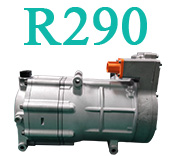
In NEV thermal management systems, heat pump technology has become an important approach to improving vehicle energy efficiency and extending driving range. With increasingly stringent environmental regulations and growing demand for low-GWP refrigerants, R290 (propane) has attracted significant attention due to its excellent thermodynamic performance. However, because of its flammability, different system architectures demonstrate clear technical differences in terms of safety, efficiency, and system complexity.
Currently,
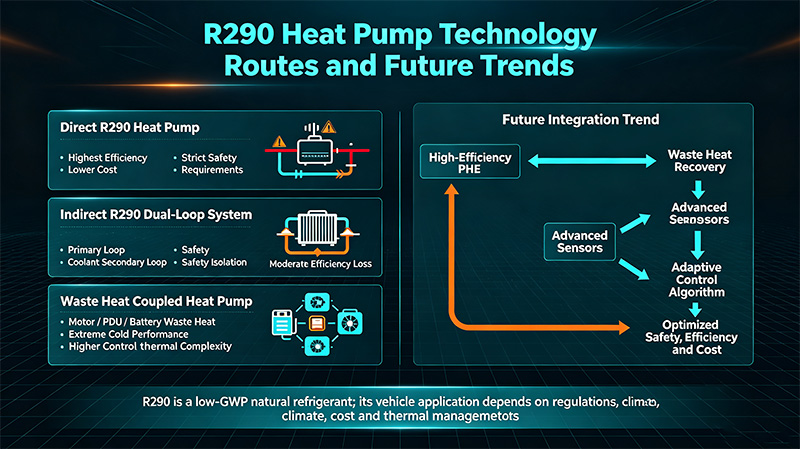
the application of R290 in electric compressors and vehicle thermal management systems can be mainly classified into three typical technology routes: direct R290 heat pump systems, indirect R290 systems combined with secondary-side coolant loops, and R290 systems integrated with waste heat recovery systems. The following section provides an engineering and scientific comparison and analysis of these approaches.
1. Direct R290 Heat Pump System
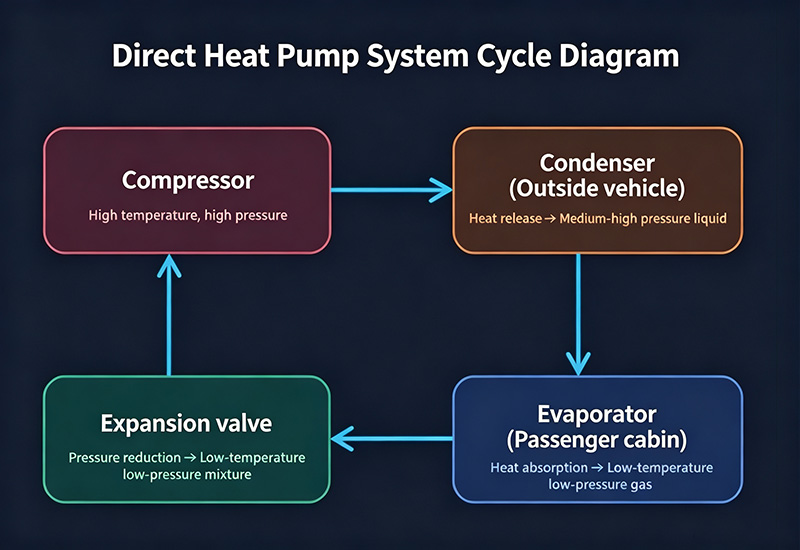
A direct R290 system is the most traditional configuration and is closest to conventional refrigeration circuits. In this architecture, R290 directly circulates between the evaporator and condenser, participating directly in the heat exchange process inside the vehicle cabin.
From a thermodynamic perspective, R290 offers high latent heat of vaporization and excellent heat transfer characteristics. Its cycle efficiency is comparable to, or even higher than, that of R134a and R1234yf. Under the same operating conditions, the system COP is generally higher, especially under low and moderate ambient temperature conditions. Therefore, this solution provides significant advantages, including the highest efficiency, the simplest system architecture, and the lowest overall cost.
However, the high efficiency of this approach comes with extremely demanding safety requirements. Since the refrigerant directly enters the in-cabin heat exchanger, any leakage could result in R290 accumulation inside the passenger compartment. According to ASHRAE standards, R290 is classified as an A3 refrigerant, meaning it has high flammability. Its flammability range is approximately 2.1%–9.5% by volume in air. Therefore, the system must incorporate advanced safety measures, including high-precision refrigerant leak detection, rapid power shutdown mechanisms, and forced ventilation systems. In addition, higher requirements are imposed on pipeline sealing performance and structural safety design.
Overall, direct R290 heat pump systems are more suitable for applications that are cost-sensitive and supported by mature safety design capabilities, such as A00, A0, and A-segment battery electric vehicles. These compact and economical NEVs typically prioritize cost optimization, high energy efficiency, and system reliability. By adopting appropriate safety strategies, direct R290 heat pump systems can effectively meet vehicle thermal management requirements while maintaining competitive system costs.
Typical system configuration:
| Refrigerant |
R290 |
| System Configuration |
Direct Expansion Heat Pump System |
| Refrigerant Charge Amount |
80–120g |
| Key Components |
18–24cc Electric Scroll Compressor + Microchannel Heat Exchanger |
System Performance Advantages:
| Feature |
Description |
| Excellent Low-Temperature Heating Performance |
R290 refrigerant offers outstanding thermodynamic performance, significantly improving the winter heating efficiency of heat pump systems in new energy vehicles. • At an ambient temperature of -10°C, the heating capacity can exceed 3.5 kW with a COP ≥ 2.4. • At an ambient temperature of -20°C, the heating capacity can still reach approximately 2.8 kW. The system maintains high heat pump efficiency even under extremely cold operating conditions. |
| Stable Operation Across a Wide Temperature Range |
The system provides excellent environmental adaptability and can cover the year-round thermal management requirements of new energy vehicles. • Supports low-temperature start-up down to -30°C. • At an ambient temperature of 40°C, the cooling capacity can reach 7.5–8.5 kW. Meets vehicle HVAC thermal management requirements under both extremely cold and high-temperature conditions. |
| Cost Advantages |
Compared with heat pump systems using R1234yf refrigerant, the direct R290 solution requires only approximately 5%–10% additional system cost, while providing superior low-temperature heating performance, higher energy efficiency, and lower environmental impact. It offers excellent overall cost-effectiveness. |
2. Indirect R290 + Secondary Coolant Loop System
The indirect R290 heat pump system introduces a secondary coolant circuit (typically using a water-glycol mixture) to confine the R290 refrigerant within the front compartment or an independent sealed module. Heat exchange with the passenger cabin is achieved through the secondary coolant loop, enabling physical separation between the refrigerant circuit and the vehicle interior environment.
From a safety perspective, this architecture significantly reduces the risk of R290 entering the passenger compartment. Even in the event of refrigerant leakage, the impact is generally limited to the front compartment or external refrigeration system area, effectively improving the overall vehicle safety level. Therefore, when exploring the application of flammable refrigerants, indirect heat pump systems have become one of the preferred technical solutions considered by many automotive OEMs.
However, the introduction of a secondary heat exchange circuit also brings new technical challenges. Since the system involves a multi-stage heat transfer process of “refrigerant → coolant → air”, additional thermal resistance and energy losses are introduced compared with direct expansion heat pump systems, resulting in a certain reduction in overall COP. Meanwhile, the addition of components such as coolant pumps, plate heat exchangers, and associated piping increases system complexity, leading to higher vehicle cost, weight, and control strategy requirements.
Despite these challenges, indirect R290 heat pump systems still offer significant advantages in markets with strict safety regulations or high requirements for vehicle safety. This solution is mainly targeted at B-segment, C-segment passenger vehicles, and SUVs, especially models designed for the European market, with safety, thermal management performance, and regulatory compliance as the core design objectives.
The system adopts an indirect R290 heat pump architecture combining R290 refrigerant and a secondary coolant loop. Through refrigerant circuit isolation, key hardware optimization, enhanced low-temperature thermal management capability, and multiple safety redundancy designs, the system achieves an optimal balance between vehicle thermal management performance, safety, and reliability while complying with European regulatory requirements.
Core System Architecture and Hardware Configuration:
| Category |
Description |
| Working Fluid Circuit Design |
The system uses R290 propane refrigerant with a controlled refrigerant charge of 100–150 g. The key feature is that the refrigerant does not directly enter the passenger compartment. Instead, a plate heat exchanger enables thermal energy transfer between the refrigerant circuit and the secondary coolant loop. This fundamentally eliminates the safety risk of flammable refrigerant leakage into the cabin and meets stringent European regulations for onboard flammable refrigerant applications. |
| Compressor Selection |
Equipped with a 24–30 cc two-stage vapor injection electric scroll compressor, significantly improving heating capacity and energy efficiency under low-temperature operating conditions. |
| Integrated Thermal Management Module |
The vehicle integrates a 5-in-1 / 8-in-1 integrated thermal management module, enabling coordinated control of multiple thermal demands, including cabin heating, battery temperature regulation, and electric motor cooling. This simplifies piping layout and improves overall vehicle integration. |
Key Low-Temperature Performance Indicators (-18°C Standard Operating Condition)
| Performance Parameter |
Specification |
| Heating Capacity |
Stable heating output of 6.5–7.2 kW, meeting the rapid cabin heating requirements of vehicles operating in extremely cold regions. |
| System COP |
Overall energy efficiency ratio COP ≥ 2.7, demonstrating excellent low-temperature heating efficiency. |
| Extreme Low-Temperature Start Capability |
Reliable startup capability at temperatures as low as -40°C, suitable for severe cold regions and Nordic export markets. |
| Additional Cost Increase |
Compared with the basic direct expansion solution, vehicle system cost increases by approximately 10%–15%, representing an acceptable performance and safety premium for mid-to-high-end vehicle platforms. |
Dual-Circuit Operating Principle
The complete system consists of two fully isolated circuits: the primary refrigerant circuit and the secondary coolant circuit.
| R290 Refrigerant Circuit |
Electric scroll compressor → External condenser → Electronic expansion valve → Plate heat exchanger
The refrigerant circulates only within the front compartment area and does not enter the passenger cabin. |
| Secondary Coolant Circuit |
Plate heat exchanger (absorbing heat from refrigerant) → Cabin heater → Battery cooler
The coolant acts as an intermediate heat transfer medium, delivering thermal energy to the passenger cabin and battery thermal management system.
Core principle:
The plate heat exchanger enables cross-circuit thermal energy transfer, achieving physical isolation between the flammable refrigerant and the passenger compartment. |
Multi-Level Safety Redundancy Design (Compliant with European R290 Regulations)
To address the flammability characteristics of R290 propane refrigerant, the system incorporates a dual-protection safety strategy to ensure passenger compartment safety.
| Safety Function |
Description |
| Leak Detection + Ventilation Protection |
Equipped with dual refrigerant leak sensors. Once R290 leakage is detected, the system automatically activates forced vehicle ventilation to rapidly dilute combustible gases accumulated in the front compartment. |
| Multi-Level Active Power Cut-Off Protection |
A hierarchical power protection strategy is implemented. Under abnormal conditions such as excessive refrigerant leakage, overheating, or overpressure, the system progressively disconnects compressor power and high-voltage circuit supply to eliminate potential fire and explosion risks.
|
3. R290 + Waste Heat Recovery System (Electric Drive / Battery Integrated)
Designed for dedicated vehicle platforms operating in extremely cold climates with a primary focus on improving winter driving range, the R290 indirect heat pump + two-stage vapor injection + integrated electric drive/battery waste heat recovery thermal management system represents one of the most advanced technology solutions in the field of low-temperature thermal management. This architecture achieves an optimal balance between environmentally friendly refrigerants, passenger safety, and winter range performance.
The entire system maintains the indirect dual-circuit architecture to ensure safe application of R290 refrigerant. The R290 charge amount is controlled within 120–180 g, while a plate heat exchanger physically isolates the flammable refrigerant from the passenger compartment, meeting the onboard safety requirements for A3-class refrigerants.
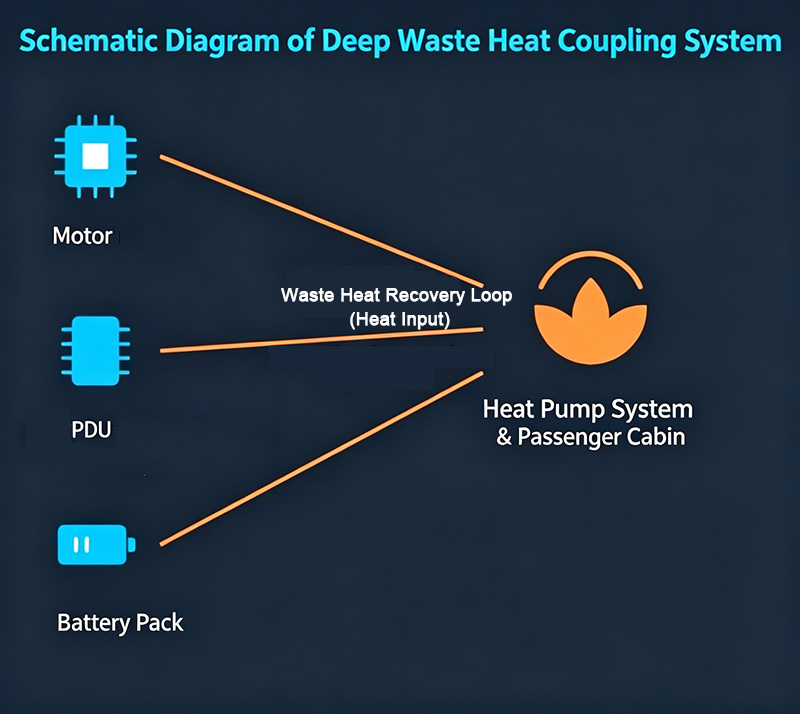
On this foundation, the system integrates two-stage vapor injection compressor technology with a deep waste heat recovery mechanism that couples multiple heat sources, including the electric motor, power electronics, and traction battery. Combined with a fuzzy adaptive intelligent heat pump control algorithm, the system enables real-time coordinated scheduling and optimization of multiple heat sources, effectively addressing the industry challenges of reduced heating efficiency of conventional air-source heat pumps and significant winter driving range loss under extreme cold conditions.
From a fundamental thermodynamic perspective, when electric vehicles operate under extremely cold conditions of -20°C or below, conventional air-source heat pump systems suffer from excessively low evaporating-side temperatures, which directly results in a significant increase in compressor pressure ratio and a substantial reduction in overall system COP.
In this solution, the waste heat recovery loop continuously captures thermal energy generated during the operation of the MCU, PDU, electronic control systems, and traction battery, and transfers the recovered heat into the heat pump heat exchange circuit. This effectively increases the evaporating-side temperature, reduces compressor workload, and fundamentally improves low-temperature heating efficiency.
According to engineering test data, under the standard extreme cold condition of -20°C, the waste heat-coupled R290 heat pump system can provide a stable heating capacity of 4.5–5.2 kW, with a system COP ≥ 2.7. Even at an ultra-low temperature of -25°C, the overall system COP can still remain above 2.4.
Meanwhile, the cabin heating response speed is improved by more than 25%. Compared with conventional air-source heat pump systems without waste heat recovery, this integrated solution improves overall system energy efficiency by more than 20%, ultimately achieving a significant 30%–50% improvement in winter driving range. This makes the technology highly suitable for electric vehicles operating in northern regions, Nordic countries, and other extremely cold climate markets.
However, the deep waste heat coupling architecture also presents challenges in terms of system complexity.
The system must simultaneously manage the dynamic allocation of multiple heat sources, including:
- Ambient air heat source
- Electric motor waste heat
- Power electronics waste heat
- Battery waste heat
This requires multi-channel temperature and pressure sensors for integrated data acquisition, combined with a fuzzy adaptive control algorithm to achieve precise energy management under various operating conditions, including driving, charging, and cabin heating scenarios.
If the thermal management control strategy is insufficiently calibrated or the multi-source heat flow distribution logic is not properly optimized, potential issues may arise, including:
- Heat source interference
- Reduced overall heating efficiency
- Decreased system operating stability
Therefore, this technology places higher technical requirements on VCU hardware/software development, thermal management strategy design, and system calibration.
As a result, this solution is better suited for dedicated vehicles operating in extreme cold regions and premium battery electric vehicles that require maximum winter range performance and advanced thermal management capability.
Development Trends of R290 Heat Pump Technology
Overall, the three major R290 heat pump technology routes demonstrate clear engineering trade-offs:
| Technology Route |
Key Advantages |
Main Challenges |
Typical Application |
| Direct Expansion R290 Heat Pump System |
Highest system efficiency, lowest manufacturing cost, simplified architecture |
Requires strict vehicle-level explosion prevention and refrigerant leakage protection design |
Cost-sensitive compact EVs such as A00, A0, and A-segment vehicles |
| Basic Indirect R290 Dual-Circuit System |
Superior passenger safety through physical isolation of flammable refrigerant using a secondary coolant loop |
Additional heat transfer losses, increased system complexity and cost |
B/C-segment passenger vehicles and SUVs, especially European market models |
| R290 Heat Pump with Deep Electric Drive/Battery Waste Heat Recovery |
Outstanding low-temperature heating performance and significant winter range improvement |
Highest complexity in multi-source thermal coordination and control algorithm calibration |
Premium EVs and vehicles designed for extreme cold regions |
Future Development Direction of R290 Thermal Management Technology
The long-term development trend of the industry will move toward a multi-technology integrated approach. While maintaining the fundamental safety requirements for onboard applications, future R290 thermal management systems will further narrow the efficiency gap between indirect architectures and direct expansion solutions through the optimization of high-efficiency plate heat exchangers, reduction of heat transfer losses in secondary coolant loops, and integration of multi-source waste heat recovery and coordinated thermal management mechanisms.
With continuous advancements in high-precision refrigerant leak detection sensors, high-sealing-performance piping materials, and adaptive thermal management control algorithms, the application scenarios and vehicle coverage of natural R290 refrigerant will continue to expand in new energy passenger vehicles and light commercial vehicles.
Overall, with its advantages of high energy efficiency and ultra-low GWP, R290 represents a highly promising and practical alternative refrigerant for new energy vehicle thermal management systems. However, there is no standardized R290 solution that can universally meet the requirements of all vehicle platforms.
Automotive manufacturers need to select and optimize the appropriate technical route based on multiple factors, including:
- Target market safety regulations
- Operating climate conditions
- Vehicle cost positioning
- Overall thermal management architecture
The key research direction for future R290-based vehicle thermal management technology will be achieving the optimal balance between high system energy efficiency and maximum passenger safety, driving continuous innovation and evolution of next-generation electric vehicle thermal management solutions.
The key challenge for future R290 vehicle thermal management development will be achieving the optimal balance between maximum system efficiency and passenger safety, driving continuous innovation in next-generation EV heat pump technologies.